
My Journey to Resolute Investing A Story of Persistence, Learning, and Growth
By Norris Davis

The Beginning: A Dream Takes Shape
In 2002, I started building something I hoped would become extraordinary - a business in financial services with one clear goal: to become an expert in investment management.
But what does that really mean? For me, it wasn't about managing other people's money in the abstract or just shipping off the duties to a third-party money manager like a mutual fund. It was about becoming the best stock and bond picker I could possibly be, following in the footsteps of legends like Warren Buffett, Marty Zweig, and Jim Rogers. These were the giants whose wisdom I devoured through books and articles, dreaming that one day I might understand the markets the way they did.
By 2007, after years of reading and learning, something clicked. I began piecing together a formula that made sense to me: a way to identify quality investments before they became obvious to everyone else. My background in economics and computer science became my secret weapon. I could translate my investment philosophy into an Excel formula, turning abstract concepts into concrete strategies. Every quarter, I'd run different stocks through the program, watching the numbers tell their story, searching for those special few that met all my criteria.
Building a Team: Two Minds, One Vision
That same year, 2007, I gained something invaluable - a business partner who complemented my skills perfectly. He had a legitimate background in finance and could run industry-standard intrinsic valuation models like Warren Buffett's specific approach. Where I was still climbing the learning curve, he was already fluent in the language of Benjamin Graham's Securities Analysis—the book that had taught Warren Buffett himself. The text was too advanced for me at the time, but my partner was a devoted student of it.
Together, we became something more than the sum of our parts. We cross-checked each other's work, challenged each other's assumptions, and built portfolios for our clients that stood apart from the crowd. We weren't just picking stocks, we were building something different, something better.
An Unexpected Addition: The Data Analyst from China

In 2012, I decided to push our capabilities even further. I hired a young woman as an intern from the University of Denver—a bright graduate student from Guangdong, China, pursuing her master’s in finance. She needed an H1 Visa to stay in the United States, and I saw an opportunity for both of us. I guided her through the visa process, sponsored her application, and supported her pursuit of the Chartered Financial Analyst designation. When everything finally came together, the visa approved, the job secured, the CFA journey begun, we were ready to take our research to the next level.
Her first assignment was ambitious: run a correlation analysis to prove that my spreadsheet's output actually identified market winners over time. I also asked her to back test my entire investment philosophy and trading algorithm. The correlation analysis was unsuccessful, possibly due to a language barrier or unclear instructions. Eventually, I let that project go. But the back testing? The results were phenomenal.
When I saw the alpha—the measured outperformance versus the overall market—I was genuinely excited. This was proof that my approach could work. But then reality set in. The amount of work required each quarter to stay on top of the model was daunting. And even more challenging: I couldn't figure out how to trade a live portfolio effectively while already being fully invested. New opportunities kept appearing, but I had no elegant way to capture them without disrupting what we already owned. The old adage hit me hard: good in theory, difficult in practice.
I had my Data Analyst pivot to working the spreadsheet each quarter, and I tried to filter through the results to pick just a few investments. But that approach didn't align with our original back test, which had worked precisely because we followed the model completely. So eventually, we went back to what we knew—my partner and I working together as a team, using our combined judgment to navigate the selection process.
Loss and Understanding: When Everything Changed
In 2015, my world shifted. My Data Analyst received a call from her parents, asking her to return home to China. I was taken aback. Why would she give up the opportunity she had worked so hard for here, with the H1 visa, and everything we had built together? She left in November 2015, and I struggled to understand.
A year later, a postcard arrived from Beijing. There was a simple postscript that made everything clear: "How are you liking that new President?" Suddenly, I understood. Her parents had called her back because they were scared for their daughter. After seeing Trump in action, I honestly couldn't blame them for what they did. They were protecting their child, and that was something I could respect, even through my disappointment.
Before she left, she had passed her CFA Level I and II exams. Today, she's a full CFA working in Hong Kong with Bank of America Merrill Lynch. I'm proud to say I was part of her success story. It's moments like these (helping someone achieve their dreams) that make all the struggles of this business worthwhile.
Around the same time, my business partner started checking out, focusing on a new endeavor with his own family business. The team I had built was dissolving before my eyes.
Trying to Save What We Had Built
In 2017, in an attempt to save our partnership, we moved under the umbrella of Verus Capital Partners in Scottsdale, Arizona. They were affiliated with TD Ameritrade, now Schwab, which gave me access to incredible technology I could learn and trade with. But even that couldn't stop what was coming.
In 2018, my business partner and I officially decided to go our separate ways. Now I was truly alone with no help on the backend, no help on the frontend, and no partner to bounce ideas off.
I had to figure out my investment approach entirely by myself.
Finding Clarity in Crisis
They say your best growth moments are sparked during extremely challenging times, and I found this was certainly true for me. Being alone forced me to innovate in ways I never would have considered before.
I discovered TD's iRebal program – a system for setting up investment
models, attaching client portfolios to those models, and then simply pushing a button to let the trading engine execute everything automatically. This gave me back precious time and kept portfolios in alignment with my strategy. At first, I only used it for my mutual fund and exchange-traded fund clients. The idea of using it for individual stocks and bonds hadn't occurred to me yet.
I also started exploring investment analysis tools and even talked to UiPath, a company originally from Romania that had just set up headquarters in New York. With their expertise, we designed a bot that could streamline my spreadsheet work. The price point was significant, and I wasn't sure I was ready. It would help, but I felt I needed to get some other pieces in place first.
The Partnership That Changed Everything
Eventually, I found Zacks Investment Research—a full-service research firm that helps professionals like me with backend support. I gave them a copy of my spreadsheet and explained my dilemma: I was spending countless hours going to each SEC report for every company, gathering data, entering it into the spreadsheet, compiling it, and processing it to get a result for each stock I studied. It was exhausting and unsustainable.
Zacks was already gathering all that data. They had built a macro that worked with Microsoft called Excel Link. They created a link to their data tables, and suddenly, with the push of a button and about a minute of waiting, I had my output. All I had to do was paste it into my master sheet. This single innovation probably saved me 50 to 100 hours every quarter.
But Zacks gave me more than just time back. I started following and learning from Tim Nyland and eventually Mayur Thaker at Zacks. Collectively, they taught me additional metrics that produce long-term certainty around earnings—concepts like Return on Invested Capital and Free Cash Flow Conversion. My formula was growing more robust, my process more refined. I was producing a smaller, more focused list of companies to work from.
When Good Isn't Good Enough
Even with all these improvements, the list was still too long. I was using the Zacks Rank combined with research from Schwab, Morningstar, Argus, and S&P Global to get a consensus on which stocks to pick. This was still incredibly time-consuming and not realistic for managing real portfolios. It resulted in a lot of average hits and misses—nothing spectacular.
Eventually, I simplified my approach: I would just follow Zacks's Earnings Certain Model and be done with it. There wasn't much trading required, and over the long term, it was solid. In 2022, during a market downturn, that portfolio performed quite well compared to the S&P 500. Having only companies that weather storms well because of their consistent earnings isn't a bad thing to have.
But then 2023 happened. The market came roaring back on a wave of AI capital expenditure, and the Zacks based portfolio was left in the dust. It wasn't just left behind—it actually continued to drop because it owned companies that were being negatively impacted by inflation. Investment styles go in and out of favor in the short-term all the time. Unfortunately, a lot of clients won’t hang in there for the long-term and can only handle poor performance for 1 to 2 years.
Meanwhile, even though I wasn't actively using it, I kept working my original spreadsheet. And I noticed something frustrating: it was producing fantastic ideas that were perfectly aligned with the new AI boom. The system I had built all those years ago was seeing opportunities I was missing in my actual portfolios.
Building Something New: The Fixed Income and Energy Portfolios
At the end of 2024, I started working on new concepts derived from investment writing I'd been doing privately. These were notes to myself about changes in the investment landscape. With everything happening in the economy, I felt that traditional fixed income was going to be tough to trust over the next few years. So I built my own Fixed Income bucket of ETF’s that I felt would be resilient regardless of which direction interest rates and inflation might go. It held core bonds, precious metals, real estate, commodities, and other bond-equivalent concepts.
The other new concept was what I called my Inclusive Energy Approach. I started it in 2023 and tested it with one client, gaining strong insights. The theory was simple but powerful: build an approach the way China builds their energy infrastructure (use everything). I took every category I could think of in the energy sector, studied a group of stocks for each category, and picked one stock per category. The outcome was a concentrated portfolio of about 15 stocks designed to offer a more competitive historical risk-return profile than broad energy ETFs.
The Mountain That Taught Me Everything
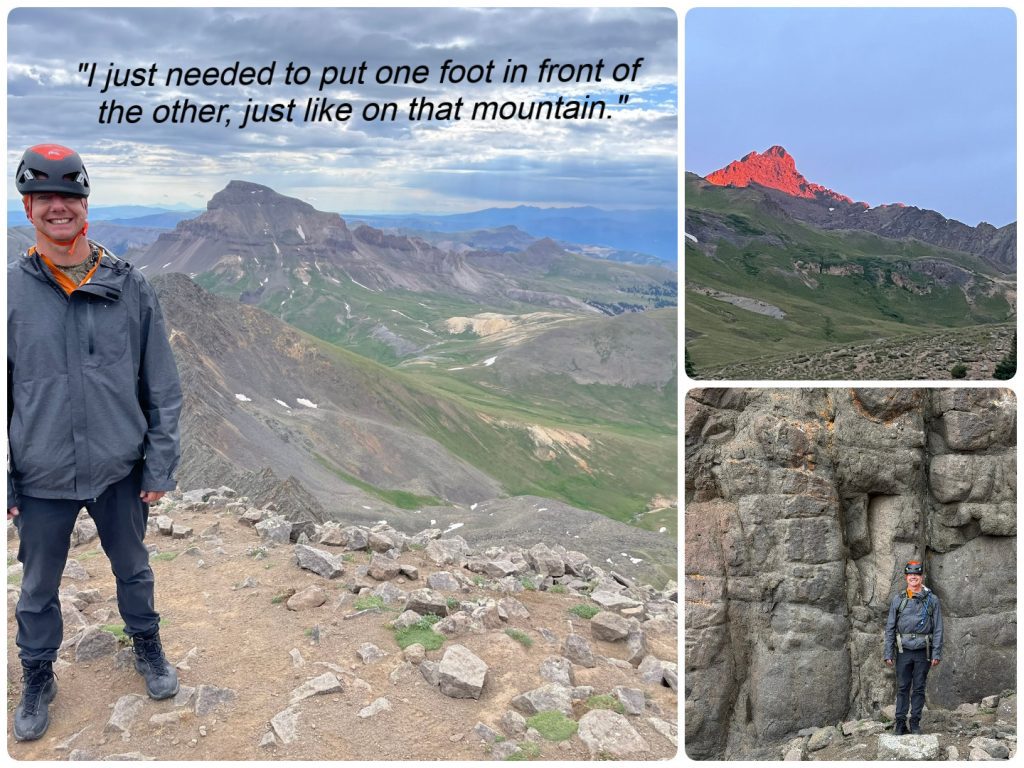
I spent the first half of 2025 stepping back from all this intensity and getting in shape for a major hike with a buddy to the top of Wetterhorn Peak. By July, I was sitting on that summit, looking out at all the other peaks we had climbed together over the years, and I found myself asking a question: Why am I able to climb these deadly mountains in the San Juans, but I struggle to climb the mountain in the stock market?
At that time, while my strategies were making upward progress that year, they were moving at a much slower pace than the major market indices.
If you've never been to the top of Wetterhorn, there's a 150-foot headwall called The Crux that's incredibly technical.
You're free climbing it. There were no ropes and no safety net. There's no looking back.
To be successful, you only think about your next step, your next handhold. Otherwise, it's a 2,000-foot drop.
As I walked down the trail back to camp, something crystallized in my mind: my investment process was too complicated. It was time to find a simple method to trade it. I just needed to put one foot in front of the other, just like on that mountain.
Simplicity: The Final Piece of the Puzzle
I started questioning everything I thought I knew. What if I could simply use iRebal to build my quarterly research results into a strategy, attach client portfolios to that strategy, and then click the button? It would mean a lot of visible trading for clients, and I worried about that. So, I took a handful of clients I knew wouldn't fire me for it and tried it.
I had two approaches at the time. One was my "Strong Buys", stocks that both my spreadsheet and the Zacks Rank agreed were good to buy. The other was my "Quarterly Buys," which included Strong Buys plus those that S&P Global, Morningstar, Schwab, and Argus agreed were buys, even if Zacks didn't. I wanted to use these for larger portfolios to keep them more diversified.
I tracked the performance carefully. I was impressed with the results. I also noticed something surprising: there wasn't much difference between the Strong Buys and Quarterly Buys portfolios. So I scrapped the "Quarterly Buys" approach, saving myself an additional 25 hours per quarter by not having to read all that other research.
A pattern emerged: the more hours I saved myself, the better my strategy became. By reducing the number of holdings, I could now include satellite sleeve ideas like my Inclusive Energy Approach. I'm currently building an Inclusive Base Metals Framework to add as well.
I can now add my Fixed Income Matrix to all client accounts, and this is where I can scale the amount of risk across my entire client base. By simplifying all of my investment research, my trading technique, and my approach to clients, I now have a peace of mind I have never had in my career. I'm not worried about market downturns or missing out on upswings. I'm confident in staying the course through all environments. If I need to scale risk back, I simply move everyone down a notch to have more Fixed Income and hit the button. The opposite is true when uncertainty clears.
Where We Are Today
Now I can focus on what really matters: finding new companies to research and removing old ones that will never make my “buy” radar. I can add new clients all day long because the underlying number of accounts doesn't add to my workload.
My next big project for 2026 is to figure out how to do even less trading. One thought is to analyze the company universe twice per year instead of every quarter. My performance, by the way, has not only caught up with the S&P 500, but it’s also seeking permanent outperformance.
There's still significant work each quarter. As quarterly earnings come out, I run the macro, copy it to the master sheet, look at the numbers myself, and compare what ranks high against the Zacks rank. If something hits, I put it into the iRebal software. I also keep track of what was a hit last quarter but is now downgraded, taking those out of the strategy and deciding whether to sell immediately or put a trailing stop loss on them.
But to get to this point - to have a system that works, that I trust, that performs well - after all these years of struggle, is a place I'm happy to be.
A Message of Gratitude
I want to say thank you to all of my current and past clients. I have always had a deep admiration for all of my clients. Because my client’s success has always been my number one priority, they are the ones who drive me to succeed. Most of all, I want to thank all of my clients who stuck by my side through all this adversity, through all these years.
You truly don't know how much you mean to me and how much I care for each and every one of you.
For Public Use | Tracking #1078705-01-03